Financial Data & Research / Ongoing · Private
TradeMind.
A private financial-market research platform connecting live market feeds, historical data infrastructure and reproducible analysis workflows.
A research-grade market-data foundation with ingestion, provenance, recovery and analytical workflows.
READ THE CASE STUDY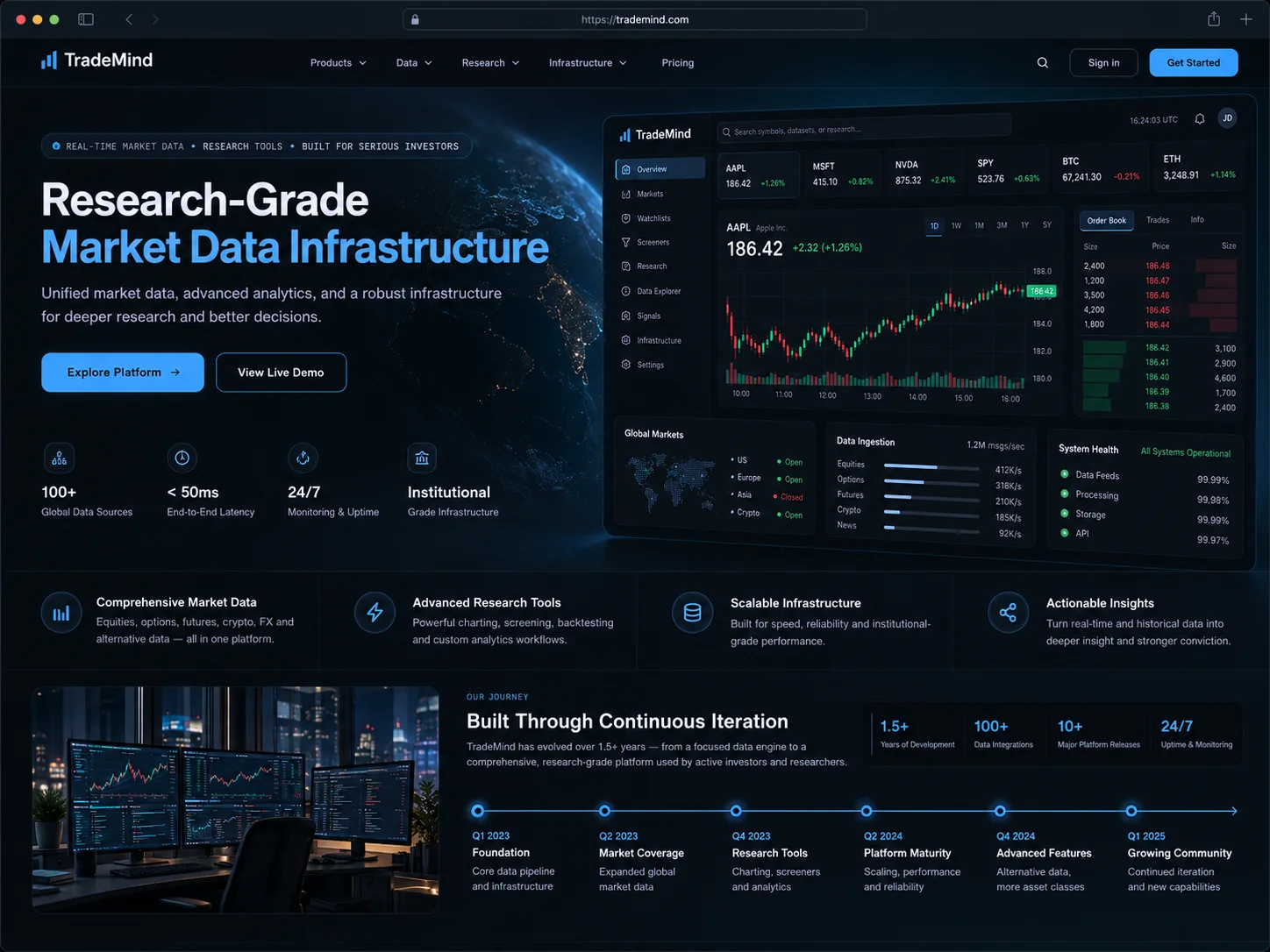 ILLUSTRATIVE INTERFACE CONCEPT
Interface concept only. Illustrative figures, dates and labels within the image do not represent verified platform statistics or a public deployment.
The challenge
Financial information is fragmented across providers, each with different symbol conventions, timestamps, precision rules, historical coverage and streaming behaviour. A market-data research platform needs more than charts: it needs a defensible record of what actually arrived, when it was observed, and how it was subsequently processed.
Disconnections, duplicates, interrupted writes and historical revisions can undermine reproducibility. TradeMind is an ongoing engineering response to those problems.
The approach
I have been developing TradeMind as a locally operated market-data and research environment, combining Python services with React-based interfaces. The architecture separates original provider evidence from normalized storage and analytical interpretation:
Market providers → ingestion and source evidence → canonical data lakes → deterministic analysis → research workflows.
Provider integration work includes Binance market data and cTrader-related foreign exchange and precious-metals feeds, using REST or WebSocket patterns as appropriate. The system treats historical reconstruction differently from market events that cannot be recovered after an outage.
The ten-lake foundation
TradeMind organizes financial information into ten logical domains, each with its own ingestion and validation responsibilities:
- RawLake — original provider records, identity and provenance.
- CandleLake — historical and live OHLCV intervals.
- QuoteLake — bid/ask observations.
- TradeLake — executed and aggregate trade events.
- OrderBookLake — market depth snapshots and sequence-sensitive updates.
- DerivativesLake — funding, open interest and related metrics.
- EventLake — economic and corporate events, including updates and revisions.
- NewsLake — attributed news and publication records.
- ReferenceLake — symbols, instruments and reference mappings.
- OnChainLake — blockchain-related market observations.
This separation keeps collection, storage integrity and subsequent market interpretation from being mixed together.
Engineering focus
The work has included high-frequency ingestion boundaries, SQLite-backed persistence, indexing, compressed segments, durable queues, deterministic deduplication, startup/restart recovery and tests for correctness under interruption. On the frontend, market dashboards and operational views translate complex records into understandable workflows.
Point-in-time correctness is a central design constraint: a historical researcher should not accidentally use information that had not yet been observed or published at the time being studied.
Status and boundaries
Private R&D — ongoing. TradeMind is not a public SaaS product or live trading service. The accompanying visuals are design concepts, not authenticated screenshots of the current local runtime. Numbers and dates shown within those concepts must not be read as verified uptime, latency, throughput, exchange coverage or development history.
Parquet/DuckDB analytical readers and next-generation stabilization are elements of ongoing or target architecture; they are not described here as a completed, production-certified replacement. No private repositories, provider credentials or sensitive internal endpoints are published.
What this project demonstrates
Building across the entire stack, from real-time data capture to recovery mechanisms and user-facing research tools — with a particular focus on accuracy, traceability and the engineering trade-offs behind reliable data systems.
Technologies & disciplines
PROJECT DOCUMENTATION
VISUAL STORY.
Images are author-provided interface concepts, not screenshots of a public running product.
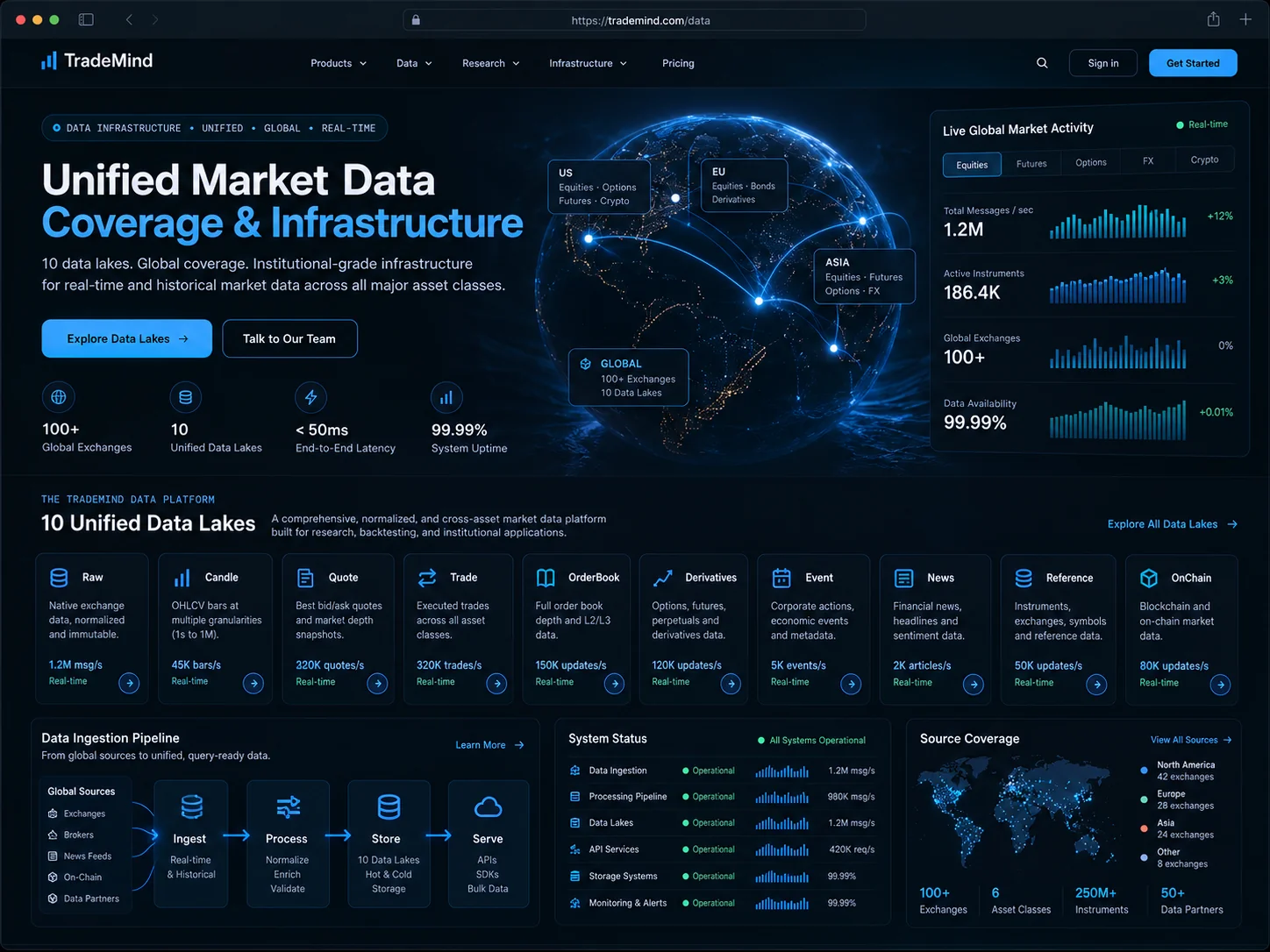
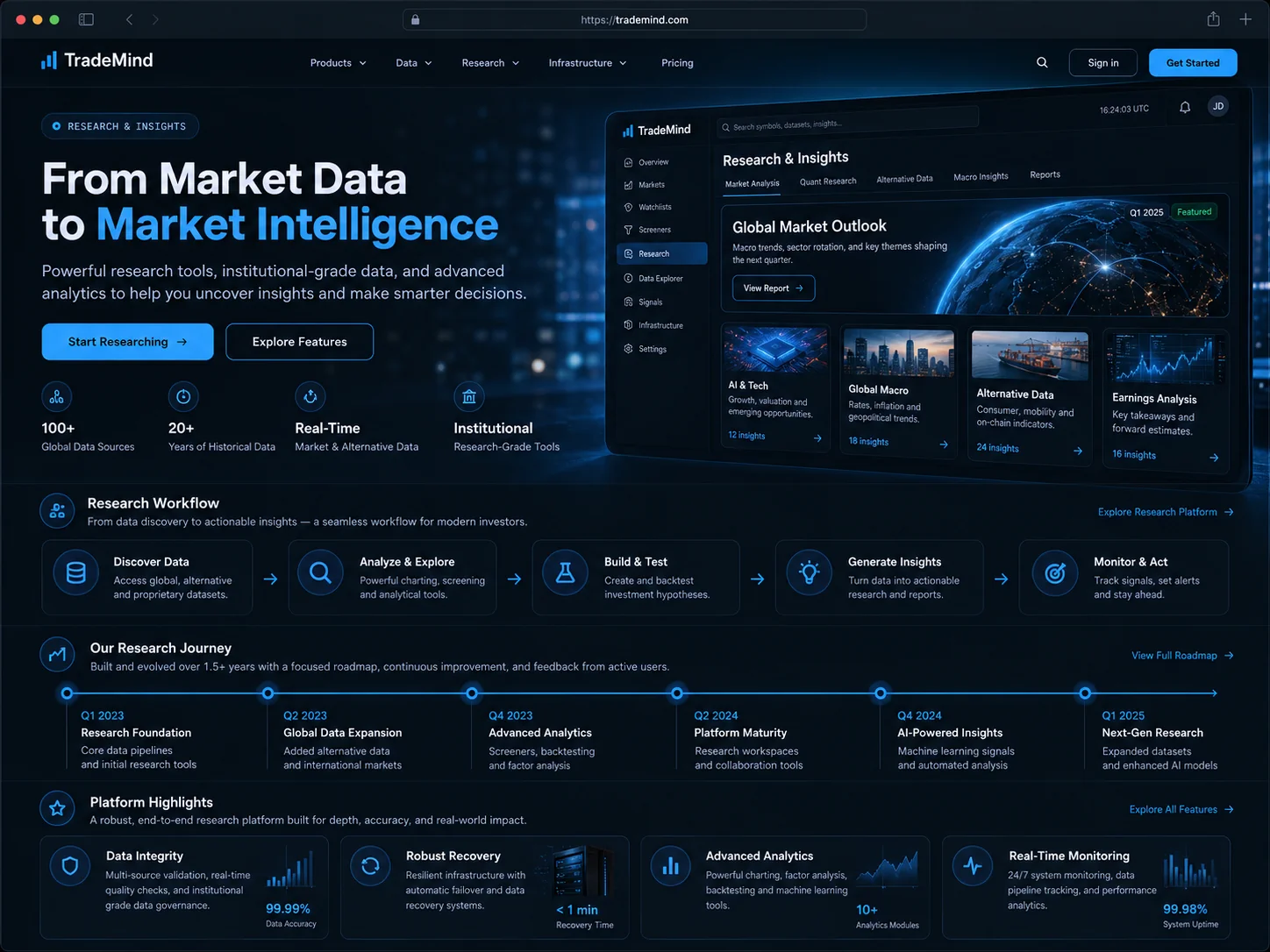
TradeMind visuals were supplied by the project owner and are marked as design concepts.